
Download printable version
Procurement Policy
GENERAL PROVISIONS
Background
Sollio Agriculture, the Agri-business Division of Sollio Cooperative Group, is a Canadian leader in the agriculture industry. It specializes in supplying farm inputs and providing value-added services that benefit farmers, cooperatives, and partners.
Its business model combines the strength of a local approach with the power of a national presence to offer innovative products and solutions, promote the adoption of sustainable farming practices, and help local farming families prosper. It has a nationwide presence, 1,300 employees and, annual sales of $2.8 billion.
Purpose
The purpose of this policy is to establish and communicate Sollio Agriculture’s principles and expectations regarding the procurement of raw materials, goods and services. The philosophy behind this policy is to build strategic partnerships with suppliers as a way of promoting the purchase of products and services that are environmentally, socially and economically responsible.
This policy aims to:
Define the scope of the policy and the roles and responsibilities of the supply chain group
Communicate Sollio Agriculture’s reference criteria, which support the organization’s core business and its social and environmental values
Inform suppliers of Sollio Agriculture’s procurement processes, rules and standards
This policy was designed to foster the success of suppliers who share the same strategic and responsible procurement values as Sollio Agriculture.
Roles and responsibilities of the supply chain group
The supply chain group is responsible for all activities related to strategic raw material purchasing, indirect procurement, logistics and transportation, and administrative support services for purchases from—and sales to—business units. The group is also responsible for managing the integrated planning process and ensuring the timely availability of raw materials. The group uses best practices to deliver optimal procurement as per Sollio Agriculture’s strategic vision.
The supply chain group works closely with internal stakeholders to optimize the end-to-end value chain. They act as collaborators by:
Actively participating in multidisciplinary governance structures established by the supply chain group in order to provide knowledge and technical expertise on goods and services
Providing the group with feedback on the value chain’s competitiveness, quality and efficiency
Informing the group of any compliance issues with suppliers
The supply chain group is responsible for administering and enforcing this policy, which can only be amended by the vice-president of supply chain.
Scope of the policy
This policy applies to all Sollio Agriculture employees and business units involved in strategic raw material purchasing, indirect procurement, logistics and transportation, and administrative support services for purchases from—and sales to—business units. It applies to all suppliers doing business with Sollio Agriculture and its business units.
This policy applies to the following raw material product categories:
Fertilizers
Nitrogen products
Potash
Phosphorus
Other fertilizers
Crop protection products
Insecticides
Fungicides
Herbicides
Adjuvants
Other crop protection products
Feed products
Amino acids
Medicinal additives
Grain
Palmitic fats
Pharmaceutical products and veterinary services
Proteins
Vitamins and minerals
Other feed products
This policy also applies to indirect procurement for:
Maintenance, Repairs and Operations
Equipment used on sites
Professional services (consultants, services, training)
Administrative expenses (insurance, maintenance, office supplies)
Marketing (advertising, translation)
Information technology (software, equipment)
Travel expenses
In addition, this policy applies to transportation and logistics activities required to move the above products, as well as to administrative support.
The above list is not exhaustive and may change over time.
Responsible practices
Sollio Agriculture is committed to being a responsible company, addressing climate change, and bringing about positive change in agriculture. It aims to have a positive and measurable impact on the environment, in the communities where it operates, and on the wellness of its people across all its activities. To achieve this, Sollio Agriculture has developed a commitment-based corporate responsibility action plan.
The supply chain group is a vital part of the plan. It communicates the principles and expectations of responsible procurement to Sollio Agriculture’s suppliers and positions corporate responsibility as a key element of the organization’s partnership programs. Sollio Agriculture wants to work with suppliers who share its values and adopt responsible practices.
REFERENCE CRITERIA
Sollio Agriculture’s procurement approach is based on the following criteria, some of which can be found in the Working Alliance:
Competitiveness, risk management, and continuous improvement (price, quality, on-time delivery)
Optimize life-cycle costs
Foster innovation and the use of technology
Nurture collaborative relationships and partnerships
Increase climate resilience
Business ethics
Comply with applicable laws, regulations, and business practices
Combat fraud, corruption and embezzlement
Avoid conflicts of interest
Disclose all information relating to business ethics
Avoid gifts, travel and entertainment
Protect assets, personal and confidential information, and intellectual property
Environmental protection
Minimize our environmental footprint (greenhouse gases, water, biodiversity, natural resources)
Comply with applicable environmental laws and regulations
Help Sollio Agriculture meet its environmental commitments
Respect for human and animal rights, health, and welfare
Respect human and labour rights
Promote the principles of diversity, equity and inclusion
Ensure worker health and safety
Ensure animal health and welfare
Sollio Agriculture expects its suppliers to meet the requirements set out in this policy and to share best practices in strategic procurement and responsible practices.
Similarly, all employees in the supply chain group are expected to deal fairly, honestly and objectively with all suppliers. The Working Alliance is a document that provides general guidelines for all Sollio Agriculture employees to help them make decisions that are aligned with the company’s values. Adherence to the principles of the Alliance ensures that employees comply with federal and provincial legislation as well as Sollio Agriculture’s internal rules and policies.
PROCUREMENT PROCESS
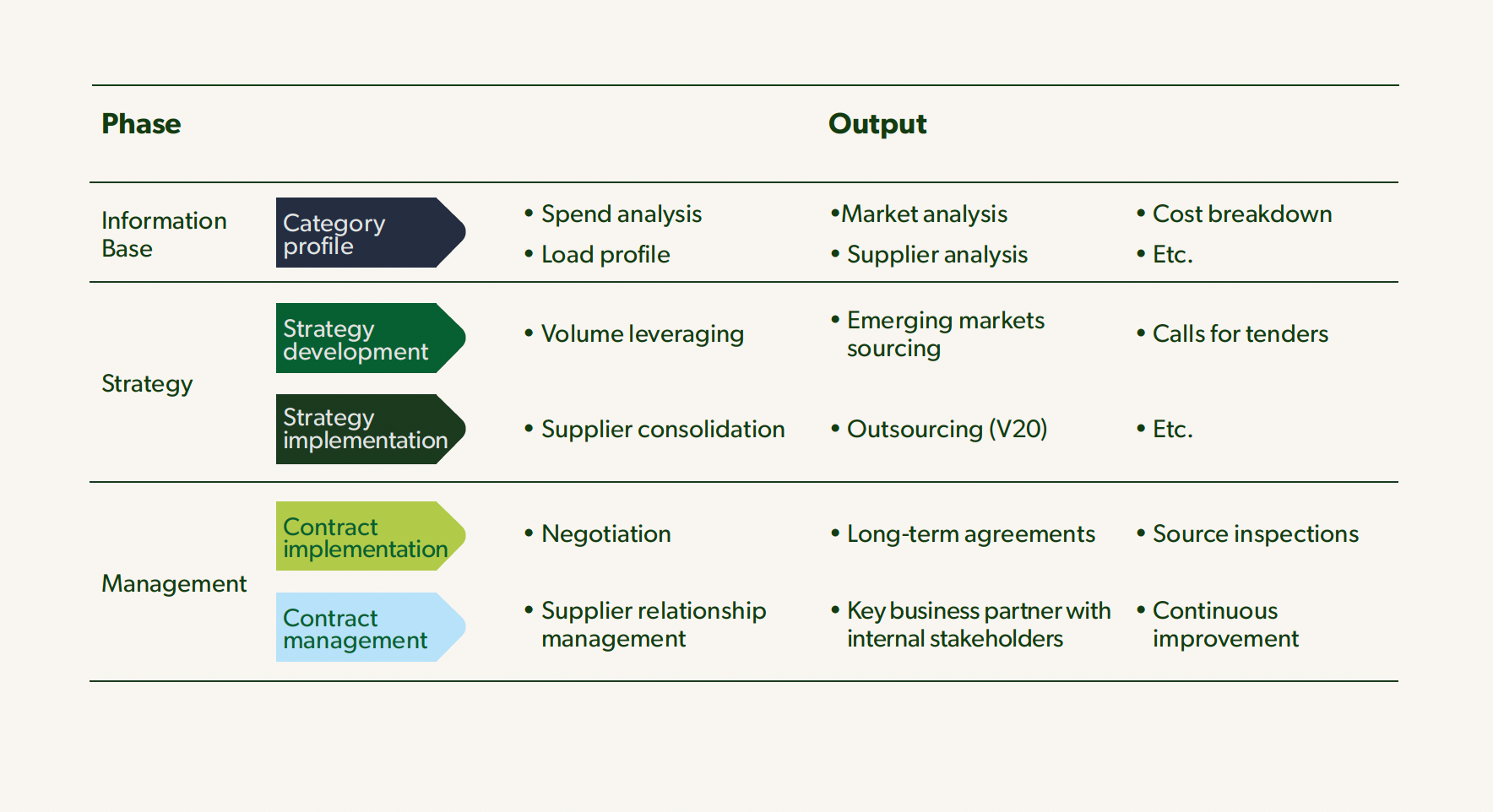
In general, goods and services will be procured in accordance with the category-based management process defined in Appendix 1. Exceptions may be made where special circumstances warrant. In such cases, no procurement will occur without the involvement of the vice-‑president of supply chain, who will ensure compliance with this policy.
Evaluation of new suppliers
Before Sollio Agriculture commits to a new external supplier for products listed in 1.4, the supply chain group must evaluate the supplier to ensure that it meets Sollio Agriculture’s criteria for recognition as a strategic supplier.
The evaluation covers the supplier’s performance in terms of sales, product quality, on‑time delivery, innovation, financial stability, collaboration, and corporate responsibility.
Supplier selection takes into account market concentration, supplier criticality, country of origin, and industry.
If a supplier does not meet expectations, they are given recommendations for corrective action and must deploy an action plan to meet Sollio Agriculture’s selection criteria. The supplier will be reevaluated at least every two years based on the results of the initial evaluation.
Supplier performance management
The supply chain group is responsible for establishing robust governance structures with strategic suppliers to develop key performance indicators for evaluating supplier performance on a regular basis. Performance evaluations must be well documented and shared with suppliers and business partners to support their continuous improvement and competitiveness. Suppliers must be informed of the impact their performance will have on Sollio Agriculture’s decision to award them new contracts.
Agreements and contracts
Sollio Agriculture’s commercial transactions must be governed by long-term agreements with its business partners. The supply chain group is responsible for managing contracts and supplier relationships. All contracts and contract amendments must be reviewed and approved by the Legal Affairs Department.
In the absence of a signed agreement, purchase orders are considered binding contracts. As with contracts, purchase orders must be in total compliance with the Delegation of Authority Policy.
Delegation of authority
The approval management process is governed by an internal delegation of authority grid that is set according to requirements specific to Sollio Agriculture.
Agreement renewals
Agreements can be renewed, but such renewals are subject to the same review and approval rules as for initial agreements. Tacit agreements and renewals are not allowed. All agreements must have a binding end date. The agreement management process should allow sufficient time for the agreement renewal process to be completed before an agreement expires.
Verbal agreements
Verbal agreements present many control problems and must be avoided. If a verbal agreement is necessary, it should be documented as soon as possible and followed by a written agreement within a reasonable period of time. The agreement should be reviewed and approved by the Legal Affairs Department, and the documentation should include a justification for the use of a verbal agreement.
Agreement records
Contract records must include an unalterable electronic copy of the entire agreement with a fully executed signature page. If a new contract is signed, an electronic copy will be kept for seven years after the agreement expires.
Tools to support the procurement processes
In managing procurement processes, the supply chain group also applies the principles set out in the following documents:
The Environmental Policy
The Packaging Policy for Eco-Design in Accordance with Federal and Provincial Regulations
The Corporate Responsibility Action Plan
The Delegation of Authority Policy
This list is not exhaustive and may change as needed.
IMPORTS
Customs and import considerations
The supply chain group is responsible for managing the operational aspects of importing. This includes ensuring that customs declarations are timely and accurate, that instructions for suppliers are up to date, and that records are retained in accordance with regulations. All Sollio Agriculture employees involved in operations must comply with import regulations.
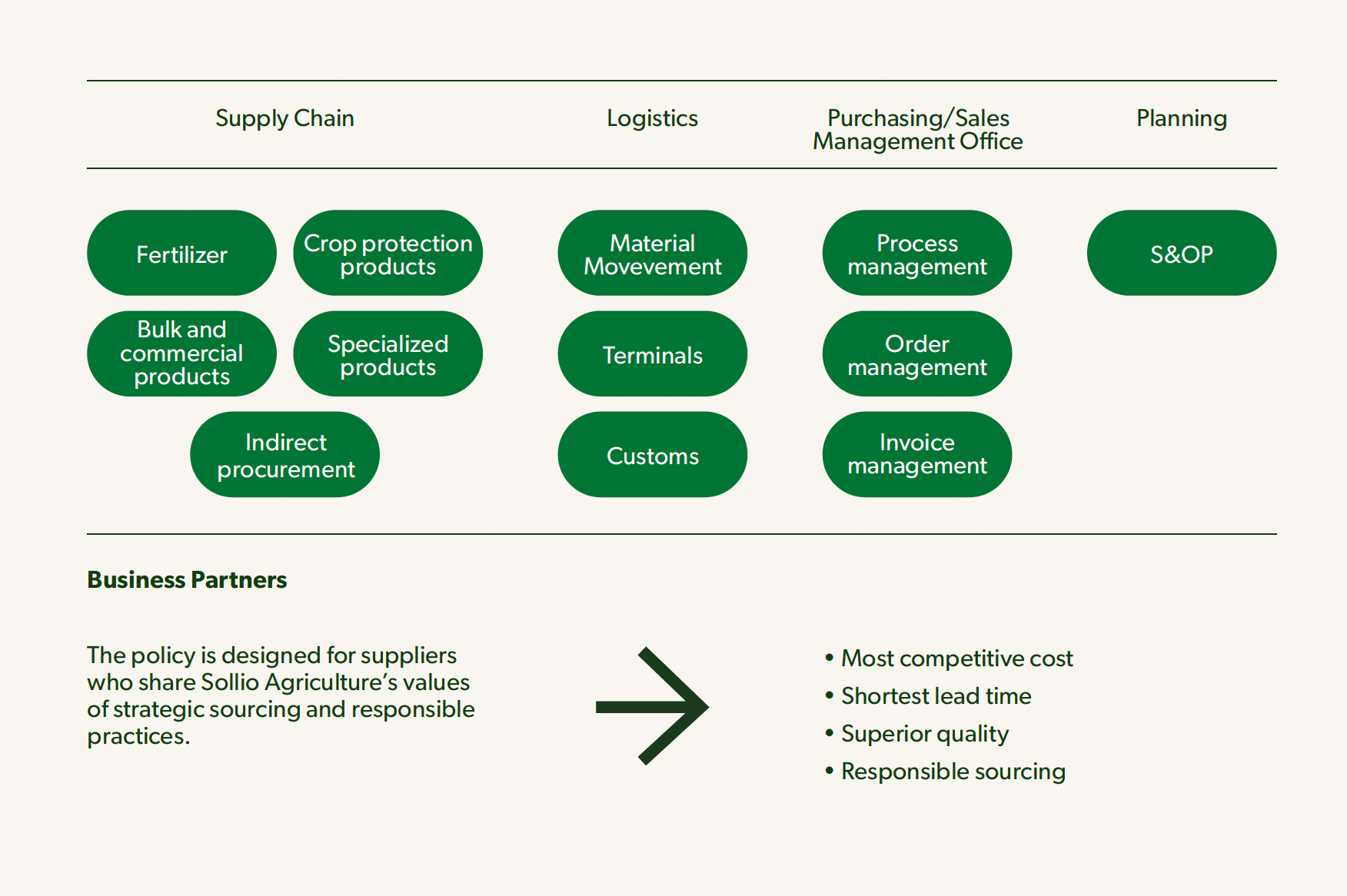
Appendix 1: The Supply Chain Function
To what and to whom does the policy apply?
The supply chain: A fundamental element of long-term corporate sustainability
The Supply Chain Function
Appendix 2: Supply chain group process
Appendix 3: Definitions
Business partner
A person, function, community, organization or entity that Sollio Agriculture associates or works with to carry out a joint action in a business, undertaking, negotiation or project.
Contract
A binding agreement between Sollio Agriculture and a supplier to acquire or obtain goods or services.
Contract value
The total amount in Canadian dollars to be paid under a contract or contractual agreement, including:
The price of the goods or services to be delivered during the term of the contract, including all options and changes
Outlays and other related costs (travel costs, shipping costs, overhead costs, profit margin, administration costs, tools and materials, duties, etc.) charged by a supplier or entity
All applicable taxes (including any non-recoverable taxes)
Direct procurement
The acquisition of raw materials and production assets needed to manufacture a company’s commodities.
Evaluation criteria
In the context of procurement, a benchmark, standard, or element of comparison against which the achievement, compliance, performance and suitability of a person, solution, activity or product are evaluated in order to select the best supplier. The criteria may be qualitative or quantitative.
Governance structure
The way in which the supply chain group is organized to put processes and control structures in place for decision-making, reporting, and evaluations.
Indirect procurement
Purchases that are needed by a company but that are not used to manufacture its commodities.
Internal stakeholder
A natural or legal person or group of individuals in Sollio Agriculture’s environment who have an interest in the company’s operation and results.
Life cycle cost
The total cost of a product over its life cycle, from design to use.
Procurement
The process of obtaining goods and services, from planning to the end of the procurement life cycle.
Procurement strategy
A strategy that specifies, in broad terms, how goods and services will be acquired:
To obtain the best value
In accordance with the highest standards in the decision to proceed on a competitive or non-competitive basis
Using applicable approaches in support of long-term benefits or other objectives, priorities or programs established by Sollio Agriculture
Risk
Uncertainty arising from exposure to undesirable situations and outcomes. It is the expression of the likelihood of an event happening and its repercussions that could impede the achievement of Sollio Agriculture’s objectives.
Service
For the purposes of this policy and its related guidelines, a service is obtained as a result of formal agreements—such as contracts, memoranda of understanding, and letters of agreement—to further the achievement of specific objectives.
Supplier
A person or legal entity that provides or could provide goods or services.
Sustainable agriculture
For Sollio Agriculture, any model of production that accounts for the human, ethical, environmental, and economic impacts of production, with the goal of optimizing the processes involved and adapting to both climate change and society’s ever-evolving expectations of the agri-food industry.
Sustainable agriculture must be a means of establishing minimum requirements and fostering positive outcomes while allowing for compromises and competing priorities.
The Working Alliance
Sollio Agriculture’s commitment to providing its employees across the country with a safe, caring, and inclusive workplace. It’s also a way of establishing a code of ethics so that Sollio Agriculture can be a partner of choice for farming families and fulfil its mission of ensuring their prosperity. It’s a tool that serves Sollio Agriculture’s corporate responsibility commitments, by ensuring both the well-being of its employees and the good governance of the organization.